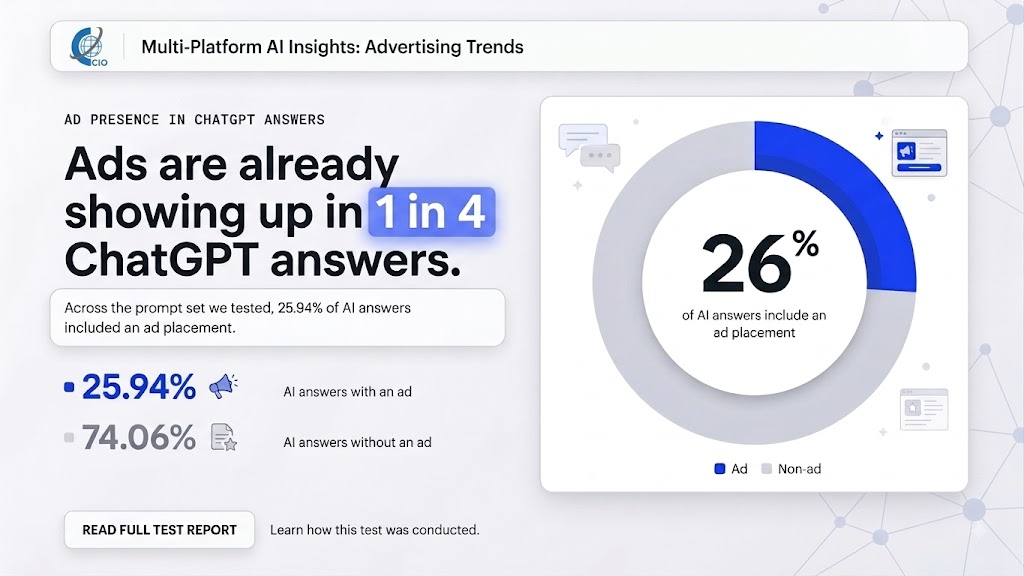
ChatGPT now shows a sponsored result on roughly one in four commercially-intent prompts — a real, measurable ad channel, not an experiment. But a large-scale analysis of over 50,000 prompts also found that around one in seven of those ads had no real connection to what was actually asked. For any business weighing whether to follow their ad budget into ChatGPT, that gap between reach and relevance is the whole story.
This breakdown is built on a study published by SE Ranking in August 2026, plus their own live campaign test, with our own read on what it means for advertisers — particularly smaller and mid-size businesses deciding whether it's worth testing yet. Full original study here.
What OpenAI Says About Its Ad Principles
OpenAI CEO Sam Altman announced the rollout himself, laying out where the company draws the line — namely, that ad spend won't buy influence over what ChatGPT actually tells you:
Worth holding that principle up against the data above: OpenAI isn't selling influence over the answer itself, but the relevance and citation-overlap numbers show the ad and the answer are already running as two fairly disconnected systems in practice — which cuts both ways for advertisers and users.
How Common Are ChatGPT Ads, Really?
Across 50,006 commercial prompts analyzed in the study, 25.94% returned an ad — close to the 29.45% ad rate measured on Google's AI Mode over the same period. The two platforms differ in density, though: ChatGPT currently shows a single ad slot per answer, while AI Mode showed two competing ads in 71.1% of its ad placements. For now, a ChatGPT ad placement means your ad isn't sharing space with a direct competitor in the same answer.
Ad presence also swings hard by category — from 61.2% of Pets prompts down to just 9.3% of Real Estate prompts, against a 25.94% study-wide average. Insurance (50.4%) and Business (37.7%) also ran well above average, while Finance (15.2%), Travel (15.0%) and Education (14.2%) sat well below it.
The Relevance Problem: 1 in 7 Ads Miss the Mark
Frequency is only half the picture. The study measured how closely each ad's content actually matched the prompt and answer it appeared alongside, using similarity scoring rather than a simple keyword check. Overall, 14.35% of ads showed no meaningful connection to their prompt — and that average hides some very uneven results by category:
| Category | Ad Mismatch Rate |
|---|
| News & Politics | 54.2% |
| Relationships | 51.1% |
| Healthcare | 5.0% |
| Travel | 4.0% |
| Pets | 2.6% |
In practice, that means a prompt like "best dating apps for a serious relationship" returned an ad for a clothing retailer, and a question about a newspaper subscription surfaced an ad for a Texas electricity provider. Neither is a targeting failure in the traditional keyword sense — it's a sign of how differently ad matching works on a conversational platform.
Why Ads End Up in the Wrong Conversation
ChatGPT ad matching runs on natural-language "context hints" that advertisers write to describe their target conversations, rather than the keyword and match-type system PPC managers are used to from Google Ads. Because there's no rule-based matching layer, and advertisers currently can't see which specific prompts triggered their ads, loosely related conversations can get matched in — especially in lower-volume niches where the system has fewer clean signals to work with.
ChatGPT vs. Google AI Mode: Niche by Niche
Ad density varies a lot by category and platform, and the differences aren't small. Healthcare ads appeared roughly 10x more often on ChatGPT than on AI Mode, and ChatGPT ran News & Politics ads over 4x as often too. Education flipped the other way, appearing more than 3x as often on AI Mode.
| Niche | ChatGPT | Google AI Mode |
|---|
| Healthcare | 28.69% | 2.64% |
| News & Politics | 28.76% | 6.8% |
| Technology | 28.76% | 29.4% |
| Business | 37.68% | 39.1% |
| Entertainment | 34.88% | 59.6% |
| Finance | 15.21% | 44.7% |
| Travel | 14.96% | 50.4% |
| Education | 14.18% | 50.0% |
If your category shows a big gap between the two platforms, that's a genuine signal about where the ad inventory — and the competition for it — currently sits.
A Small, Concentrated Advertiser Pool
The study identified 1,159 unique advertisers running ChatGPT ads — a notably smaller and more concentrated pool than AI Mode's 2,930. A single advertiser, BestMoney, accounted for 13.56% of all ads seen. Category leadership was even more concentrated: Hungryroot held 79.92% of Food & Beverage ad share, Booking.com held 62.57% of Travel, Robinhood held 52.24% of Finance, and TickPick held 51.03% of Entertainment & Hobbies. Early movers in several categories are already capturing an outsized share of the available inventory.
Separately, the study found advertiser domains were cited as a source in only 3.63% of ad placements, and the exact advertised URL showed up as a citation in just 0.09% of cases. Ad spend and organic AI-answer visibility currently look like two independent systems — in 96.37% of placements, there was no organic overlap at all between the ad and the answer around it.
Real Campaign Data: What a Live Test Showed
SE Ranking also ran its own test — 3 campaigns, 8 ad groups and 48 ads across the US, Canada, Australia and New Zealand over roughly two weeks.
- 97,000+ impressions and 1,263 clicks, a 1.30% average CTR
- Cost-per-click ranged $1.50–$4.00
- Delivery was uneven — the top-performing ad groups absorbed roughly half of all impressions
- No search-terms report and no visibility into which specific prompts triggered impressions
- Traffic came in reliably, but very few sign-ups followed
The gap between traffic and results traces back to who actually sees these ads: only Free and Go plan users are shown ads today, and many professional buyers — especially in B2B — sit on paid tiers where no ads appear at all. That audience mismatch, more than the mechanics of the ad system itself, is what held back sign-ups in the test.
Should You Advertise on ChatGPT Right Now?
Our take, based on this data: treat ChatGPT Ads as a small, closely-watched test, not a reallocation of existing Google Ads or Meta Ads budget. A few practical guardrails:
- Keep it separate from SEO goals. Ad spend here doesn't appear to move organic citation or AI-answer visibility, so don't justify the spend on that basis.
- Write narrow context hints first. Start specific, use negative keywords to rule out ambiguous matches, and expand only once you can see relevance holding up.
- Check who's actually eligible to see your ad. If your buyers are professionals likely to be on paid ChatGPT tiers, your addressable audience here may be smaller than it looks.
- Test with a limited, defined budget. Cheap clicks are already proven; conversion is the open question your own test needs to answer.
- Watch your category's mismatch rate. News, politics and relationship-adjacent categories carry real risk of showing up next to an oddly unrelated ad — factor that into whether this fits your brand right now.
For Gurgaon and NCR businesses already running Google Ads or Meta Ads campaigns, the practical move is to treat ChatGPT Ads as a small satellite test alongside a channel that's already proven for your category — not a replacement for it.
Not Sure Where ChatGPT Ads Fit in Your Media Mix?
We'll give you a straight read on whether it's worth testing for your category, and manage it alongside your existing PPC and Meta Ads campaigns if it is.
Data source: All statistics in this article are drawn from SE Ranking's ChatGPT Ads Study (published August 10, 2026), based on analysis of 50,006 commercial prompts and SE Ranking's own live campaign test. Figures are reproduced and discussed here with attribution; read the full original study for complete methodology.